
Real estate agents have a problem with artificial intelligence. They have adopted it almost unanimously and it is doing almost nothing for their business.
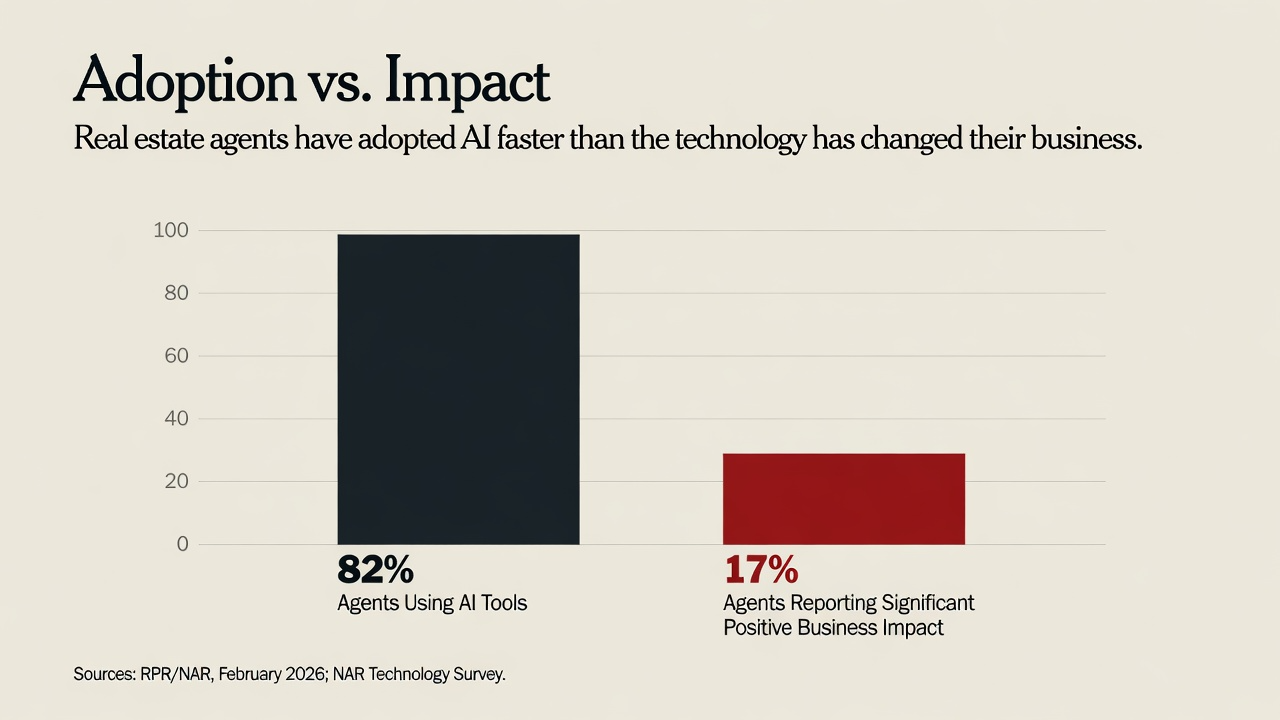
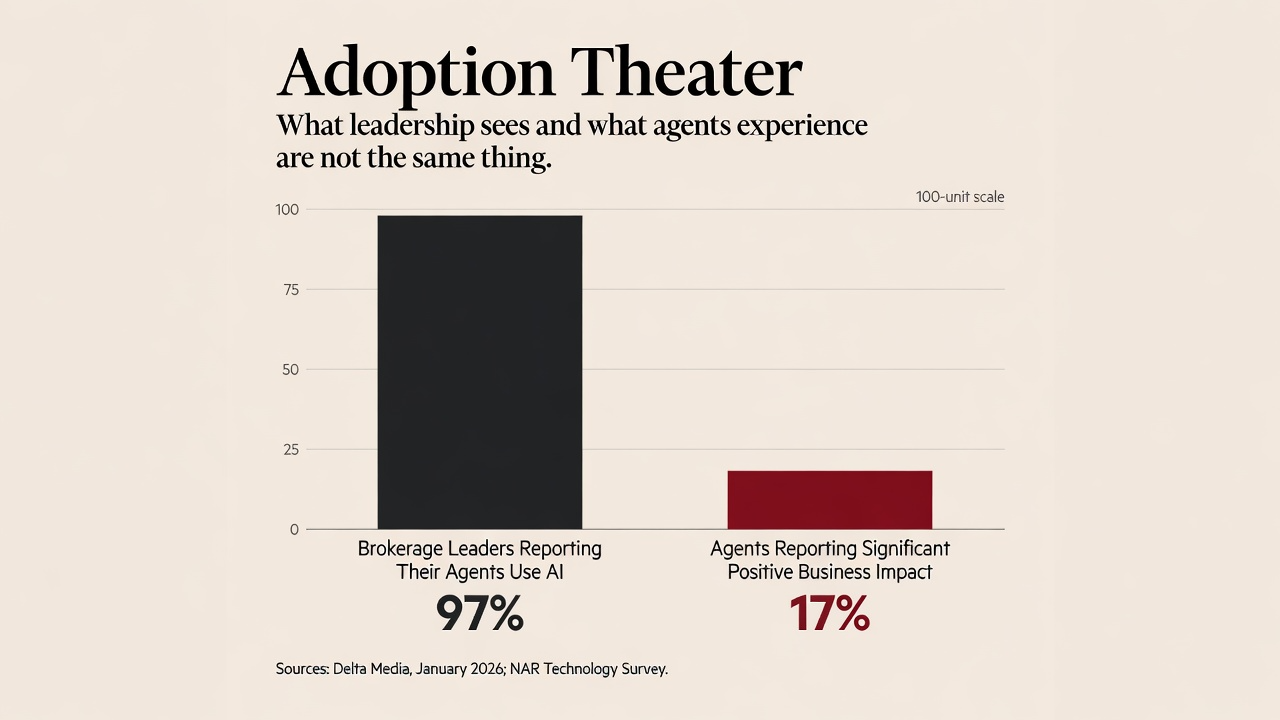
The February 2026 RPR/NAR survey found that 82% of real estate agents are using AI tools. A January 2026 Delta Media survey covered by Inman reports that 97% of brokerage leaders say their agents are actively using AI. By the numbers, the adoption story is over. AI is in the building.
The NAR Technology Survey says something different. 46% of agents report that AI has had little to no meaningful impact on their business. Only 17% report a significant positive impact. Adoption has crossed the threshold. The business case has not.
Those numbers explain each other.
AI is the new electricity. Andrew Ng said it first in 2016. Stanford has elaborated it. UC Berkeley has elaborated it. Wharton has elaborated it. The framing has held up because it is structurally correct. AI is a general purpose technology of the same class as electricity. It is the foundation layer. Every widget that claims to be powered by it runs on top of it.
That distinction is the difference between an agent who is using AI and an agent who is building on it.
The agent who treats AI as a widget opens ChatGPT, types “how do I do email marketing better,” reads the answer, and goes back to their day. The agent who treats AI as infrastructure asks “how can I use AI to power my email marketing.” They build a system. They wire it into the workflow. They run it for a quarter and rebuild it. The first agent has used a tool. The second agent has rebuilt their business on a new foundation.
The 46% who say AI has had no business impact are using the substation to charge a calculator. The 17% who report significant gains are doing what infrastructure adopters do. They use AI to power answers their business produces on its own.
The “powered by AI” software agents keep buying is a middleman that AI itself has made optional. The companies selling those products use the same underlying models any agent can access directly for the price of a monthly coffee subscription.
I spent more than two years as Director of Content at Luxury Presence. Real software, well built and well sold, delivers value the average agent cannot replicate alone. That category is not dead. The question has shifted. Asking which tool is the best on the market used to be the right question. Today, the question is whether the tool the agent is paying for every month is what they actually need, or what has been the best option until now.
The middleman provides packaging, interface, and convenience. That is real value. It is also not the only path. An agent with thirty minutes and a thesis can build an email response system, a market update generator, a follow up cadence, a comp analysis routine. The base voltage is in the wall. The widget is one of many ways to plug in.
History says this distinction matters and it stays mattering.
Agents who waited on social media missed a decade of network compounding. The connections they did not make in 2012 are the referrals other agents close in 2026. Agents who waited on email worked at a slower cadence than their clients expected, closed fewer deals, lost listings to faster competitors. Agents who waited on websites were stuck in the Yellow Pages legitimacy economy after the verification layer had moved online. The Yellow Pages still worked just fine. The verification layer their business depended on had moved online while they kept buying ads in the back of a phone book.
The counterargument to all of this is the one I hear most. “I am one person. I cannot rebuild my workflows on something that changes every six weeks. I will wait for the dust to settle and adopt what survives.”
Substitute electricity into that sentence and read it again. The uses of electricity change every six weeks. The presence of electricity does not. The agent who waits for the dust to settle is positioning themselves at the back of the pack while the green flag is already waving. There is no catching up at the halfway mark. There is just the front of the pack pulling further away.
The mindset shift is real and it is not easy. I see this every day with the agents at The Mitten Group and the agents who reach out after speaking events and on social media. For thirty years, technology adoption in real estate has followed the same path: subscribe, read the manual, watch the videos, complete the training. AI breaks that pattern. The manual changes every day. The videos are obsolete by the time you finish watching them. The training never ends because the tool never finishes evolving. The skill agents need now is sustained curiosity. There is no manual to complete. There is no certificate at the end of the path.
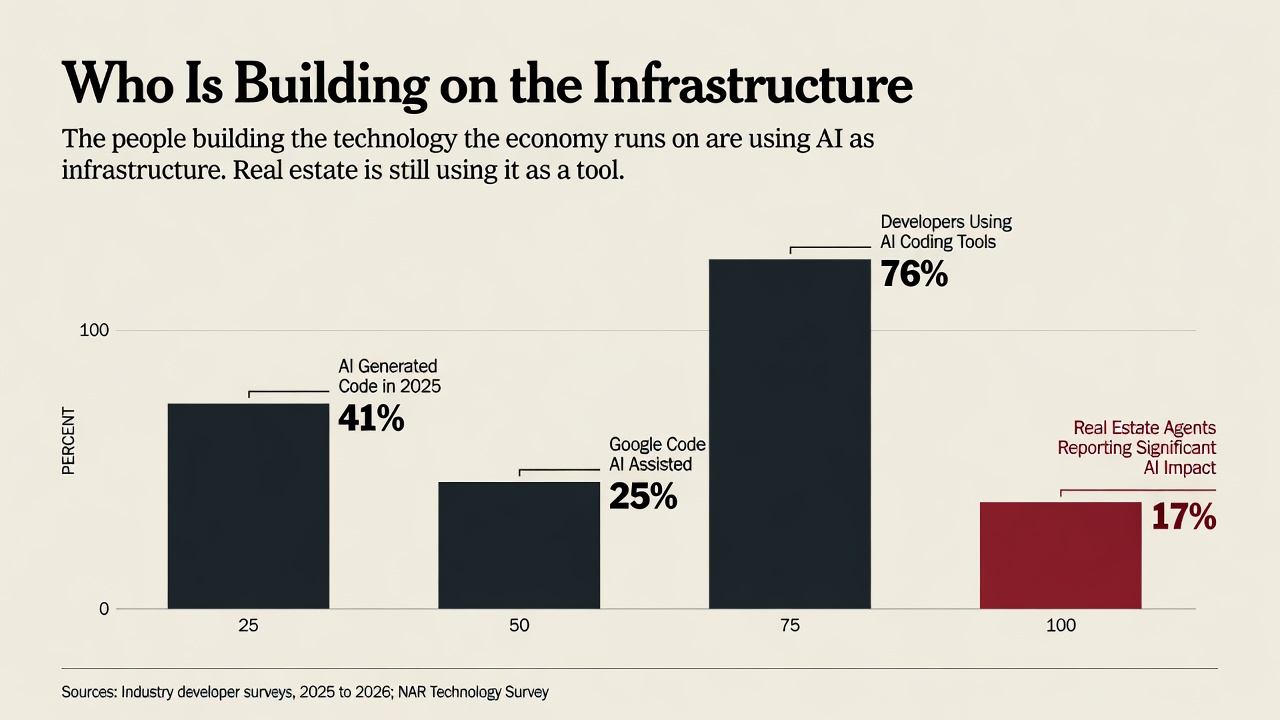
The leading edge of the broader economy has already crossed. Approximately 41% of all code written in 2025 was AI generated. High adoption organizations are on track to cross 50% by late 2026. Google reports 25% of its code is AI assisted. 76% of developers use or plan to use AI coding tools. The people building the technology the real estate industry runs on are building it with AI. That is happening now.
This is the message I am taking to the California Association of Realtors AI Now series this summer. The 46% impact gap is the most expensive number in the real estate industry right now and almost nobody is naming it. The agent who knows they are behind does not need a perfect plan. They need to stop opening AI to ask questions and start opening AI to design the systems their business runs on. Adoption was the entry fee. Building on top of it is the win. The agents who win the next decade are the ones who already stopped thinking about AI as a thing they use and started thinking about it as a thing they build on. Everyone else is paying the electricity bill and lighting one bulb.