
The most capable home buyers and sellers in history are walking into transactions right now. AI has handed them access to market data, comparable sales, contract frameworks, and negotiating context that used to require a professional to unlock. An informed client is a better client.
The harder question is what that means for the agents they are hiring.
The agents who will compete in that environment bring what AI cannot give a client: local market relationships built over years in the field, pattern recognition from hundreds of deals in the same zip code, professional judgment that identifies which problems will derail this specific transaction before they become crises. That kind of competence is real and irreplaceable. It is also not something you develop in a pre-licensing course. You develop it inside the industry, over time, doing the work. The post-settlement data makes this plain: clients with more information and better tools than any previous generation still chose to hire representation at a rate above 90 percent.
The Bureau of Labor Statistics projects real estate broker and sales agent employment to grow 3% through 2034. The licensed headcount will hold. The pipeline that produces agents worth hiring is a different matter entirely.
That pipeline runs through the ring of roles that has always surrounded the licensed agent: the transaction coordinator tracking contingency deadlines and routing documents, the administrative assistant managing calendars and listing paperwork, the marketing support staff building campaigns and social content, the office administrator who knows where everything is and keeps it all moving. AI tools are absorbing those tasks right now. Contract timelines, deadline reminders, document compliance checks, client communication drafts. In production, at scale, this year.
The industry is reading this as an efficiency gain. Lower overhead per transaction. Fewer people managing the same volume. The math looks good.
What the math does not capture is what those roles were actually producing.
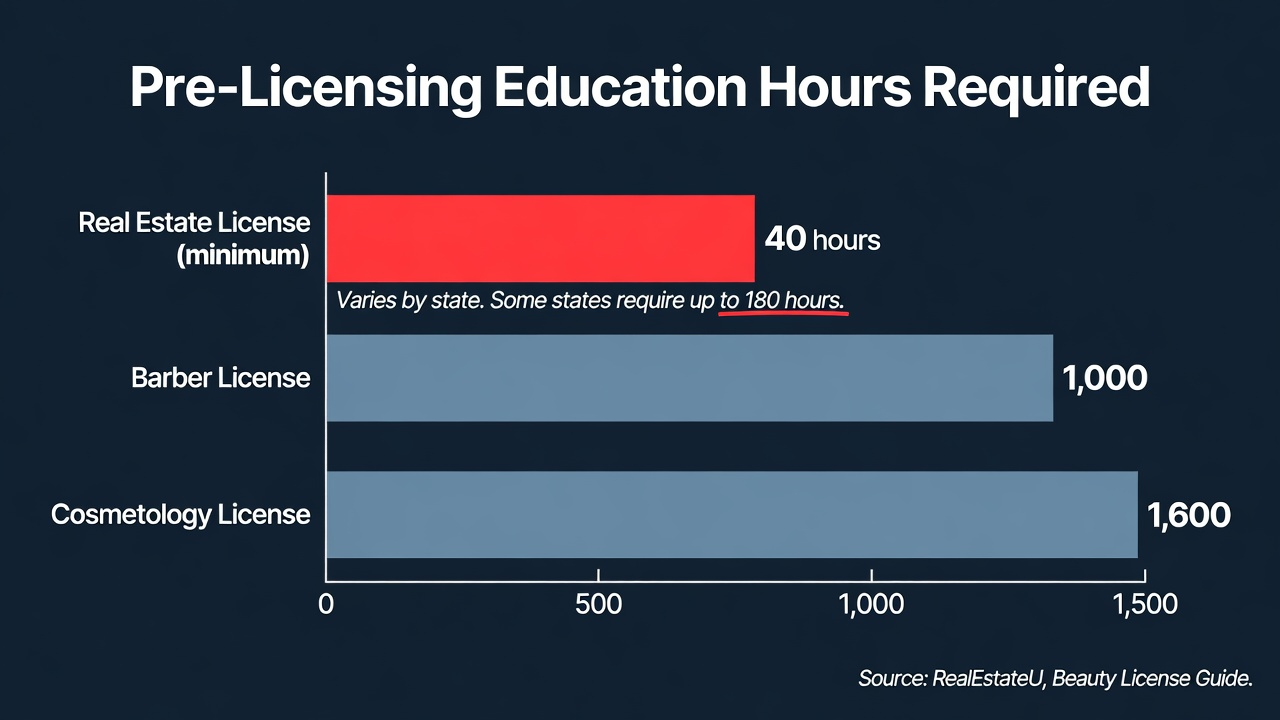
Real estate licensing requirements set one of the lowest bars of any licensed profession in the country. In some states, 40 hours of education separates someone from legal authorization to represent buyers and sellers in one of the largest financial decisions of their lives. A barber needs 1,000 hours of training. A cosmetologist needs at least 1,600. The licensing requirement protects the agent headcount. It does not produce agents who are ready for what the job actually demands.
What has always bridged that gap, informally and without any industry-wide acknowledgment that it was even happening, is the time many newly licensed agents spent in supporting roles before they ever got licensed. They arrived at licensure already knowing the business. Someone who spent two years as a transaction coordinator understands the mechanics of a deal at a granular level that no pre-licensing course addresses. Someone who ran marketing for a busy team knows how clients actually move through the decision process. Someone who sat in a brokerage front office learned what the real objections are, who the real players are, and what actually goes wrong. That pipeline is closing.
Relitix tracked new agent performance across multiple cohorts. The numbers tell a clear story. From 2017 through 2020, the year-one failure rate for new agents averaged 28%. By 2021 it was 37%. By 2022 it was 49%. Nearly 1 in 2 agents who made their first sale in 2022 could not make another the following year. The two-year failure projection for that cohort could top 65%.
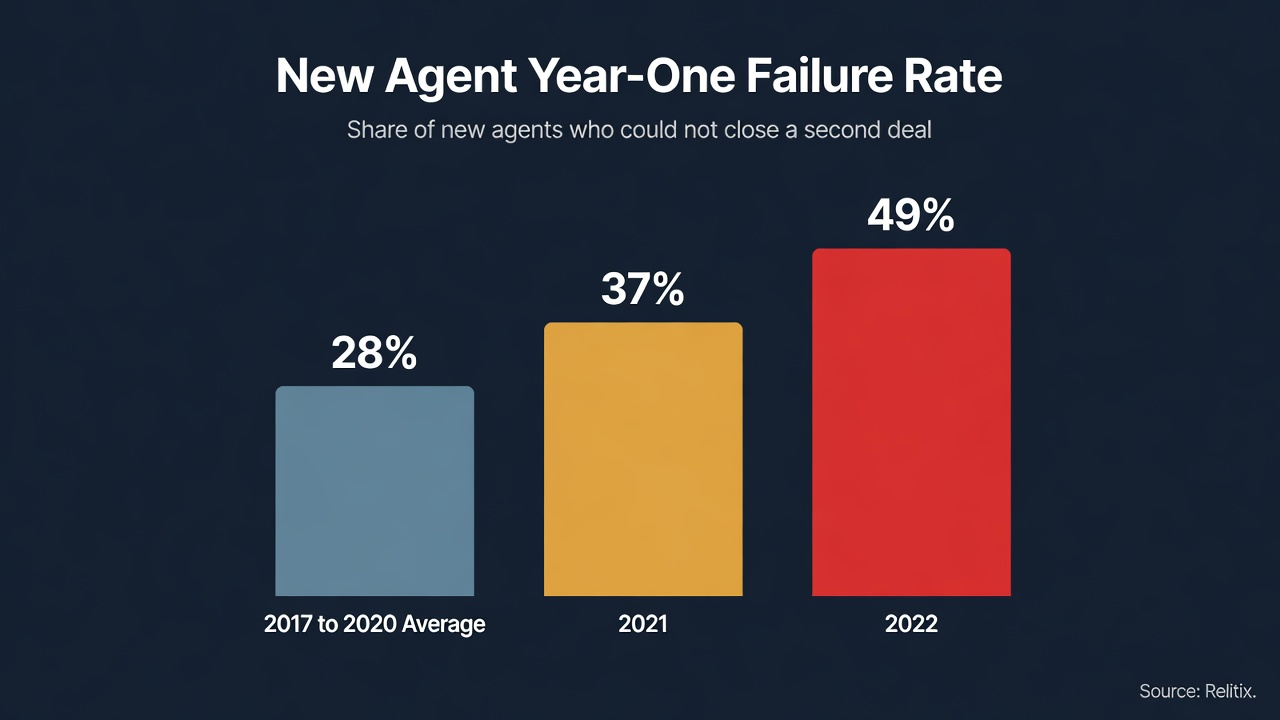
Those numbers were rising before AI accelerated support role automation at any scale. The trajectory pointed the wrong direction already. The farm system was weakening as brokerage models scaled by cutting the middle layer of experienced staff.
What happens when that layer disappears entirely?
Stanford economist Erik Brynjolfsson published research last year analyzing payroll data from millions of American workers. His finding: AI disproportionately displaces early-career workers in AI-exposed occupations, while experienced workers in the same roles hold steady or grow. The mechanism is specific. AI replaces codified knowledge, the kind you get from coursework and certification. It does not yet replace tacit knowledge, the kind that accumulates from doing the work over time, in a real environment, with real stakes.
The support roles that real estate is now automating were precisely where that tacit knowledge was being built. The industry spent decades producing agents who came in knowing something, without ever acknowledging that it was doing so, because the system looked like administrative overhead and the system was being optimized away.
The headcount will stay stable. The licensing numbers will look fine. The industry will celebrate the efficiency gains. The failure rate for new agents three years from now will be higher than it is today, and the industry will spend considerable energy explaining it in every direction except this one.
The formal apprenticeship infrastructure this industry needs will not come from NAR or state licensing boards. Individual brokerages will build it, or it will not be built.
The business case is clear. Mass consolidation has commoditized the brokerage experience. Splits, fees, branding, marketing tools: available everywhere, differentiated nowhere. The brokerage that closes the training gap between what licensing produces and what clients actually deserve is building a competitive advantage that cannot be copied. Agents who are better at the job recruit to you. They stay. Their clients notice.
At The Mitten Group, this is the daily reality. The agents coming in have less pre-license context than any cohort the industry has seen. The brokerages that build serious development programs around that reality will close a gap their competitors are pretending does not exist.