
Abundance is the most useful framework I’ve encountered for a problem every agent knows: the housing market keeps producing outcomes nobody says they want.
More inventory, faster approvals, cheaper new construction. Everyone wants these things. They keep not happening.
Ezra Klein and Derek Thompson published this book in March 2025. It became a New York Times bestseller. They write about housing, energy, governance, and scientific innovation, and what connects all four is a single argument: most of what Americans call scarcity is chosen. We built the systems that create it. We continue to operate them.
If you work in real estate, that argument is not abstract. It is your market.
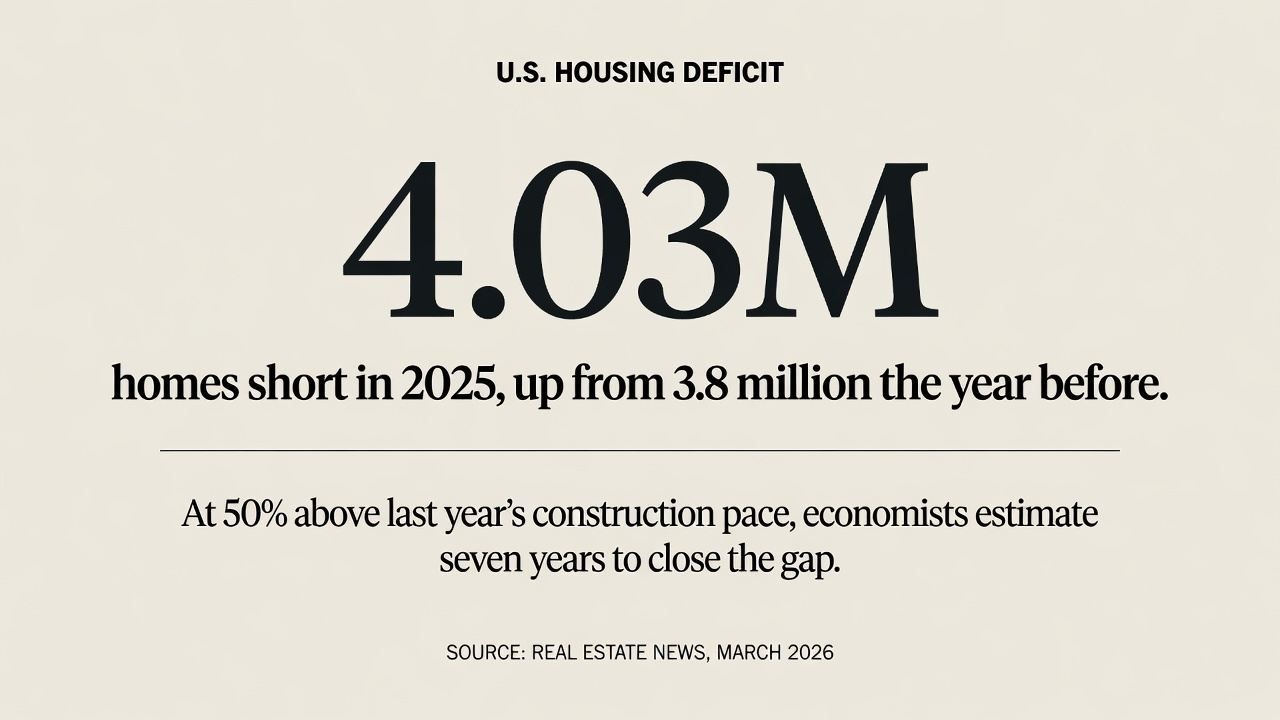
The U.S. had a deficit of 4.03 million homes in 2025, up from 3.8 million the year prior. If construction jumped 50% above that year’s pace, economists estimate it would take seven years to close the gap. Regulations account for 40.6% of apartment development costs in major markets. Klein and Thompson document the range: cities where a residential permit takes weeks, and cities where a multifamily project waits years and pays hundreds of thousands in fees before a single unit is built. Every page of this book describes the market real estate professionals work in.
Of everything in the book, the governance section stayed with me the longest. Klein and Thompson argue that mature institutions become so committed to the rules designed to protect their goals that they lose the ability to pursue those goals. Legal training becomes the default political training, which makes legal thinking (process, statutory language, commitment to procedure) the default political thinking. The outcome the institution was designed to protect becomes secondary to the process designed to protect it. Anyone who has watched a housing project die in a permitting queue has watched this in real time. Anyone who has worked inside a trade association for any length of time has watched it from the inside.
The book also refuses a comforting fiction the industry has largely accepted. Housing cannot appreciate significantly for current owners while also remaining affordable for everyone who wants to buy. These goals are structurally opposed. Homeownership as a wealth-building vehicle requires that home values increase over time. Affordability for would-be buyers requires that prices stay accessible. Klein and Thompson say this plainly. In my experience, the industry says it almost never.
A note on politics. Ezra Klein and Derek Thompson have public political views, and the book’s final pages lean into them more explicitly than the rest. This matters less than it might seem. The housing deficit is documented. The regulatory cost data is documented. The permitting timelines are documented. The conditions this book describes are the same ones that show up in declining offer volume, in buyers who can’t close, in agents who can’t find anything to show. That data does not belong to any political position. Neither does the frustration your clients carry into your office.
The critique I’ll give the book: Klein and Thompson diagnose chosen scarcity without naming who profits from it. The fossil fuel lobbies, the incumbent landholders, and the industry interests that helped write the regulations they criticize appear nowhere in the argument. Multiple serious reviewers reached this conclusion independently. A diagnosis that stops short of naming who benefits from the condition being diagnosed is a partial diagnosis. The book earns its recommendation and it has a real limit.
I gave Abundance a 7.5 out of 10. The sections on governance and housing are worth the price of the book alone. The prescription is less satisfying than the diagnosis, which is consistent with most books of this ambition and scope. Read it to understand the structure underneath what your clients are frustrated about. What to say to the next one will come from that. The industry produces an enormous volume of content about what real estate professionals should do. This book explains why the conditions they’re working in are the way they are. That is rarer and more valuable than it sounds.