
Every rate cut cycle produces the same media narrative: relief is coming, affordability is returning, buyers can get off the sidelines. The story misses the mechanism.
Lower interest rates reduce monthly payments. In a market with adequate supply, that reduction holds. In a supply-constrained market, what happens instead is documented by Federal Reserve Bank of Dallas researchers: when monetary policy eases, mortgage rates fall and home prices rise as demand increases, creating competing effects that cancel out the affordability gain. Buyers bid up prices to the new payment limit. The math offsets.
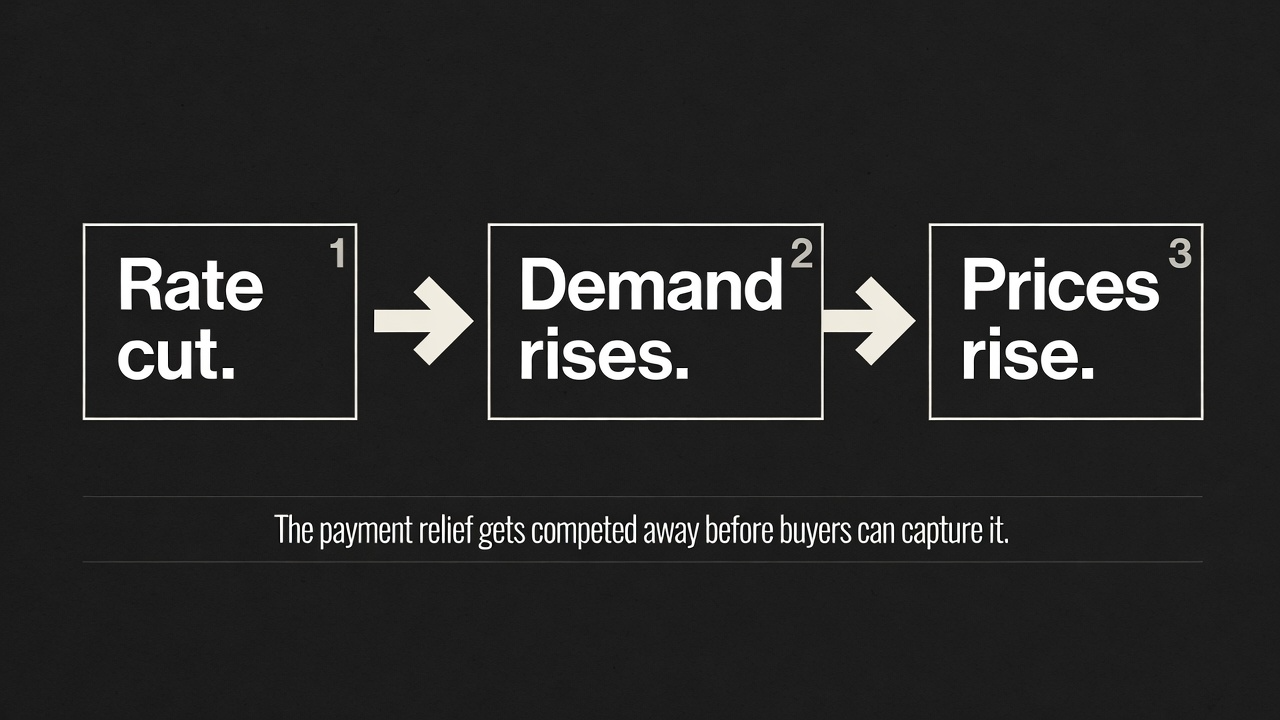
The confusion between financing costs and supply costs is not accidental. Rate cuts have a constituency. Every mortgage originator, every real estate platform, every seller waiting for the right moment benefits from a narrative that treats monetary policy as a housing fix. They need volume. A rate cut story delivers urgency. A supply story requires permits and years.
Housing comprises approximately one-third of the Consumer Price Index. In 2024, it drove 63.5% of the total CPI increase. The Fed’s mandate is price stability across the full economy. Monetary policy can change what buyers can afford to carry each month. It cannot change how many homes exist.
Real estate professionals watched this in real time. Clients who paused because rates felt hostile are still paused. The ones who acted when rates briefly dipped found that competition had returned along with them. The monthly payment moved. The purchase price adjusted to absorb it.
The housing affordability problem has two components: an inventory shortage that took decades to build and a financing cost that monetary policy can influence at the margin. Rate cuts address the second. They do nothing to the first.
Nobody in Washington is seriously addressing the first.